Featured

Net Neutrality

Net Neutrality: What is it and why do we need it?

With how prevalent the internet is today, its hard to believe that the World Wide Web only came about in the 90s, less than 20 years ago. However, since then, a lot has changed. Today, internet companies regulate the speed of internet to encourage customers to purchase more advanced and expensive plans that give them access higher speed internet. Net neutrality is the idea that these service providers should treat all content equally and therefore not blocking websites for customers who may not be able to afford pricey data plans and expediting speeds of those who are willing to pay.

“Net Neutrality: A Progress Report” written by Jan Krämer, Lukas Wiewiorra, and Christof Weinhardt describes net neutrality:

“Net neutrality prohibits Internet service providers from speeding up, slowing down or blocking Internet traffic based on its source, ownership or destination. [1]”

The article continues to point out that the biggest problem with this is that the internet service providers overtly signal that these regulations are simply put into place to generate extra revenue. The openers of the internet and fairness to customers is compromised my large corporations because they generate more profit from blocking smaller and less funded creative organizations or startup companies. Since the larger, already established corporations can fund faster and more efficient internet easily. This can create a depression in modern innovation and discourage new companies from flourishing.

Different countries have different opinions on how to handle net neutrality. “Net Neutrality: A Fast Lane to Understanding the Trade-offs” by Shane Greenstein, Martin Peitz and Tommaso Valletti states, “In the United States, the topic has fallen under the purview of the Federal Communications Commission, whose attempts to write rules have generated heated arguments, opposing votes along party lines, and repeated court review. In Europe, some individual states, such as the Netherlands, have introduced their own pro-neutrality legislations. [2]” Although there is full knowledge of what net neutrality is, the pros, cons, and consequences of internet with and without it, many governments still do not have a unified stance.

While internet without net neutrality may seem discriminatory, there are actually some benefits to it. For example, “Net Neutrality from Competing Internet Platforms,” by Marc Bourreau, Frago Kourandi, and Tommaso Valletti concludes, “In the discriminatory regime, where the two ISP’s offer prioritized lanes, Internet traffic is managed more efficiently than in the net neutrality regime. [3]” Since fewer people can afford to pay for faster internet, fewer people are on the fast lane server and therefore the internet traffic is controlled and categorized, maximizing the efficiency of it. If everyone was on the same server, the internet overall would he slower due to the high usage of the same speed.

In 2017 President Trump appointed Republican FCC Commissioner Ajit Pai as the FCC’s new chair. In April, he announced a plan to reverse the 2015 net neutrality order. While this pleased internet service providers, many Americans were outraged. People took their anger to social media, which gave them a platform to voice their opinion on the matter. Millions of posts, tweets, and videos were shared following the 2017 decision to repeal net neutrality.

These two tweets are examples of people taunting the decision to repeal net neutrality, accusing the commissioner of paying off those who voted for the repeal and expressing concern for the price rise in internet service.

Moving forward, there are a few proposals congress is considering regarding net neutrality. One proposal for complete net neutrality and returning to the regulations from 2015 already passed in the Senate but must still be voted on by the House and approved by President Trump. Another proposal focuses on eliminating broadband providers from blocking lawful content, but wouldn’t completely ban fast lanes, and would not then be a full net neutrality.

  1. Kraemer, Jan, Lukas Wiewiorra, and Christof Weinhardt. “Net Neutrality: A Progress Report.” SSRN Electronic Journal, 2013. https://doi.org/10.2139/ssrn.2344623.

2. Bourreau, Marc, Frago Kourandi, and Tommaso Valletti. “Net Neutrality with Competing Internet Platforms.” The Journal of Industrial Economics63, no. 1 (2015): 30–73. https://doi.org/10.1111/joie.12068

3. Greenstein, Shane, Martin Peitz, and Tommaso Valletti. “Net Neutrality: A Fast Lane to Understanding the Trade-offs.” The Journal of Economic Perspectives 30, no. 2 (2016): 127-49. Accessed January 22, 2020. http://www.jstor.org/stable/43783710.
Social Media Throughout my Time Abroad

            As embarrassing as it is, the social media clout was a big reason I wanted to study abroad. When choosing a host country, I spent hours combing through images of different cities’ most picturesque spots and searching photos posted by peers who have already completed their travels on Instagram. I have always prided myself on having an aesthetically pleasing Instagram feed, and I was excited for my European travels would add to my page’s look. Also, of course, showing off all the cool places I was traveling to my friends back home. I would consider myself a “social media junkie,” I love the thrill of watching notifications pop up on my screen after posting a photo. I will never take a bite of food at a trendy restaurant without Snapchatting it first. As I expected, social media continued to play a large role in my life as I traveled city to city abroad.

            The platform that I used most frequently during my time in Barcelona was Snapchat. However, that is because I used it as a way to stay in touch with friends from home, and communicate with new friends in Barcelona when I didn’t have their phone numbers. Snapchat is a great app because while it lets you show off your fun nights, yummy meals, and touristy photos, it’s also used as a major platform of communication. Since I was so far from my family and friends at home, I used snapchat more than ever to ensure we kept in close contact. While I used Snapchat the most, I placed the most value on my posts on Instagram. For me, Snapchat is much more casual and used for my closer friends. On Instagram, I will spend hours making sure the picture I post is just right and the caption is perfect. Additionally, I have a larger reach on Instagram so I value the content I put out more because it goes to more people.

            My most popular post was a picture posted on Instagram towards the end of my trip. It’s a picture of me sitting on a couch at a rooftop bar overlooking Sagrada Familia. I think this post did well for a few reasons. First off, it’s a high-quality photo with great lighting. Second, it’s in front of a well-known landmark in Barcelona, the Sagrada Familia Cathedral. This picture received 449 likes and 15 comments.

            I think the last three months have helped me to create a digital identify that differs based on the platform I am using. Instagram is my main platform. It represents the image of myself that I want others to see. My Instagram pictures and stories are the best, most high-quality photos. I always make sure images are appropriate and reflect me in the light I want them to. I try not to post too often, but still consistently on this platform. While abroad I tried to post at least one picture in every city I visited with some sort of significant landmark in that city, or a cool activity I did while there. Snapchat on the other hand, is geared more towards my close family and friends. Since I control who is permitted to view my snapchat stories, I am slightly more lenient with posts. I post more fun activates, silly videos, and lower quality images. Other than staying connected with friends back home, I mostly posted videos of nights out and food on my snapchat, while saving the better photos for Instagram. The third platform I used abroad was Facebook. I really don’t use Facebook often other than to receive information from specific groups or post albums for my extended family to catch up with my life. Facebook was important abroad because I was in a group for my program. In this group we received reminders about upcoming events and updates on the program. Additionally, I posted a few times throughput the semester with highlights from my travels so my grandparents, aunts, and uncles could see what I had been up to. Twitter was the platform I used the least. I mainly used Twitter for my own entertainment. I’ve never been big on posting my own ideas on Twitter, and that carried over throughput my abroad experience. I never posted on Twitter while in Barcelona, but I did spend hours scrolling through tweets and retweets when I was bored to get a good laugh.

            Since I used each platform differently, I think each of them told a slightly different narrative about me. Instagram told the narrative that I was a polished, and experienced traveler. Snapchat saw me as a party girl that eats out a lot. Facebook saw the studious explorer. All these different narratives come together to tell the full story. Yes, I did try my best to be put together, and yes, I tried a lot of new, exciting things. Yes, I went out to bars and clubs a lot. Yes, I studied hard and saw each new city as an education experience. I think my digital Identity has changed to reflect how I changed as a person over the past few months. My posts became more informed, more explorative, more humorous, more fearless, and more aesthetically conscious, just like I have.

Social Media and Social Credit Systems

In the episode 1 of Season 3 of popular Netflix series Black Mirror, Nosedive, the viewer is introduced to a society where every citizen is rated by other citizens. Even micro interactions have an effect on one’s score. In this episode, protagonist, Lacie, fights to raise her score to be high enough to get a discount on her dream apartment and change her life for the better. Lacie can only improve her score by receiving good ratings from her fellow citizens, even ones that don’t even know her, but simply see her on the street, or in the airport. Her good ratings boost here even higher if they are given by other highly rated citizens. This system shapes the way Lacie interacts with others. She constantly tries hard, in fact, too hard, to impress others. Lacie winds up losing herself and plummeting her score because of her “try hard” and ingenuine attitude.

Throughout our daily lives, everything we say, do or post is judged by other people. Someone might cut another person online at the coffee shop and anyone who sees is may silently label that customer as a “bad” person. Another example is if a person brings a sandwich to a homeless man, passersby may label that person as “good.” Going past just actions, after having a phone exchange with a customer service employee, meeting a new person in town, or talking to a coworker you don’t often work with, after every conversation people are left with either positive or negative impressions of the other person.  On social media, people are constantly being rated. A picture may be rated by the number of likes it receives, a video by views, or a profile by followers.  It’s always nice to be rated or judged as a good person by others, but these small interactions with strangers don’t have much impact on an individual’s life in the grand scheme of things.  But what if that all changed?

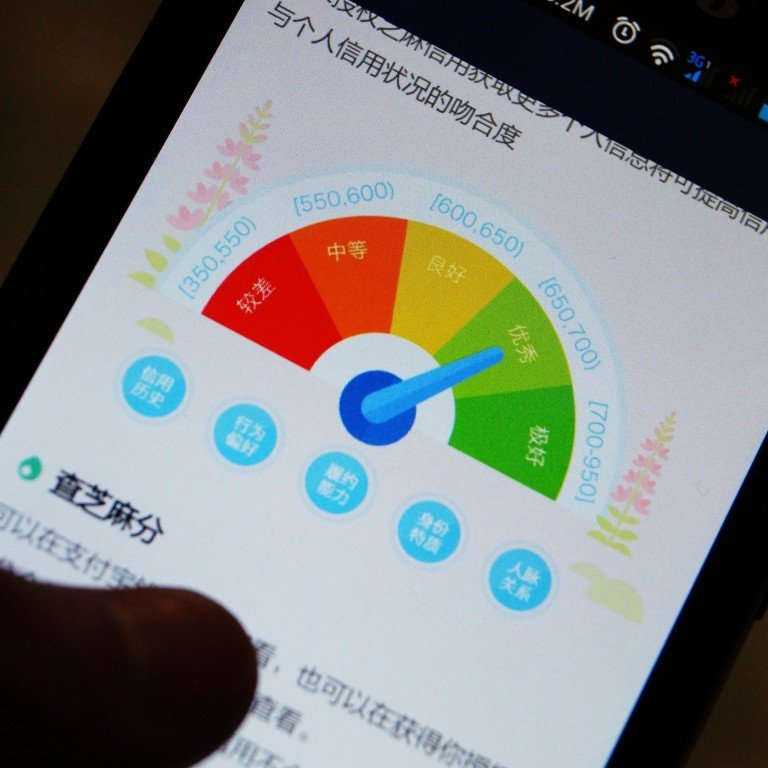
According to the article “Big Data Meets Big Brother as China Moves to Rate its Citizens” by Rachel Botsman from Wired, in 2014, China launched a system called the Social Credit System that gave citizens a numerical rating on a scale from 350 to 950. Daily interactions of Chinese citizens are constantly monitored by big data companies commissioned by the Chinese government. The scores is given to an individual based on five categories: credit history, fulfilment capacity, personal information, behavior and preference, and interpersonal relationships. A person’s score is affected by how well he or she pays bills, things he or she purchases online, where he or she goes in taxis, and who he or she interacts with. Even the scores of a person’s friends can impact their own score.

Black Mirror episodes are often scary because they represent a future where technology takes over human compassion and ethics, a future that not many hope to see. However, the Chinese Social Credit System almost makes Nosedive a reality. Many of the interactions used to rate characters in Black Mirror are used in real life to rate citizens of China. Furthermore, like in the episode, the Chinese people’s Citizen Score is used to grant them certain privileges such as faster internet speeds, better education, and ability to purchase cars without a down payment. Another way the episode mirrors the Chinese Social Credit System is the scene in the episode when Lacie cannot board her plane because her ranking is not high enough. In China, the government has the right to revoke travel privileges of citizens who do not have a high enough score.

Although the rest of the world may not have a unified scoring system for all interactions, scores that effect daily lives can be seen on a smaller level. In the article, “The Chinese Social Credit System: A Model for Other Countries?” by Síthigh and Siems, it is explained that many countries are not as far off from a social scoring system as they may believe. It states, “all major platforms, such as Uber, Airbnb, and TaskRabbit, and indeed precursors such as CouchSurfing, make use of a combination of scoring and feedback systems.” Sure, scores from these services may not affect our international travel or internet speed, but they do effect how people can interact within that platform. On Uber, both drivers and passengers are giving a rating from 1 to 5. If a score is not high enough, a driver may be fired, or a passenger may not be picked up. Uber is a good example because both the driver and the passenger are rated by the other from just a short interaction, similar to the Black Mirror episode.

If more governments move towards a social credit system, social media would play a large role in scores. As stated earlier, people are already judged based off of social media. While most of these judgements don’t have large effects, certain posts may be enough to cause an employer to pass a potential new hire up or even an organization to kick a member out of a club. However, if a government decided to rate citizens based off of all interactions, social media posts would have a much heavier weight on daily life. A post could lower a score based off of where the person in the post is located, what they are wearing or what they are doing in the post. Furthermore, a person’s friends on social media could raise or lower a score. If social credit systems become a reality all over the world, social media would become even more superficial that it is now. People already put up a front by posting only the best of their lives. If privileges and one’s life opportunities depended on social media, people would completely modify what they post and how they interact on platforms.

Botsman, Rachel. “Big Data Meets Big Brother as China Moves to Rate Its Citizens.” WIRED. WIRED UK, January 21, 2019. https://www.wired.co.uk/article/chinese-government-social-credit-score-privacy-invasion.

Síthigh, Daithí M. and Siems, Mathias. “The Chinese Social Credit System: A Model for Other Countries?” The Modern Review, 82. September 04, 2019.

Wikipedia: How it Works

When a person does a quick search on google about a topic, Wikipedia is always one of the first resources that pops up. Wikipedia is an online encyclopedia with information submitted from people all around the world. It can be a great source for basic information on a variety of topics, however, its credibility has been questioned since information comes from every-day people. I decided to investigate Wikipedia’s article publishing process myself to learn more about the website and its credibility.

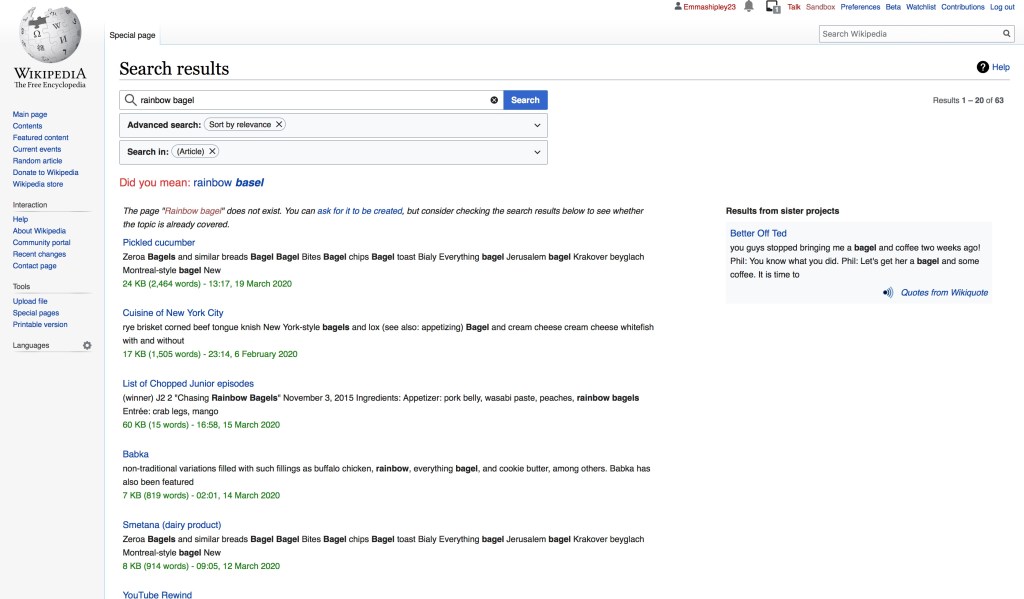
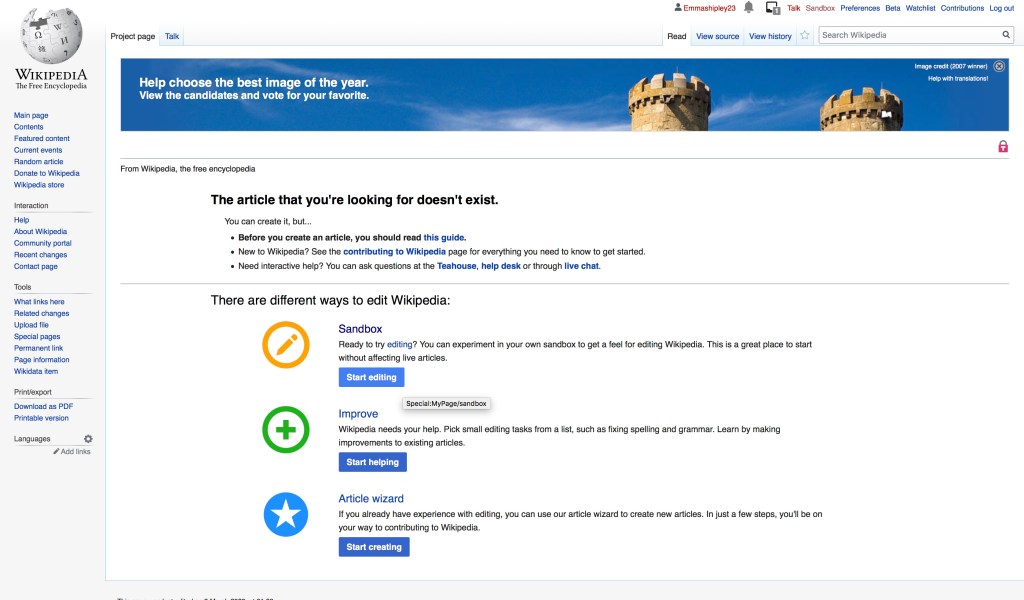
First, I researched a little bit about Wikipedia’s process. When creating a new article, Wikipedia wants to make sure that there is no other page about the topic the author wants to write. Do ensure this, the author must first do a Wikipedia search for the topic they wish to write about. If there is already a page, it will come up. However, if there is not, the term the writer typed into the box will pop up in red. To write an article about this subject, the writer must click the red words.

The writer is then prompted with the choices to practice writing the article in the Sandbox, improve writing by editing other posts, or begin writing their page in the Article Wizard.

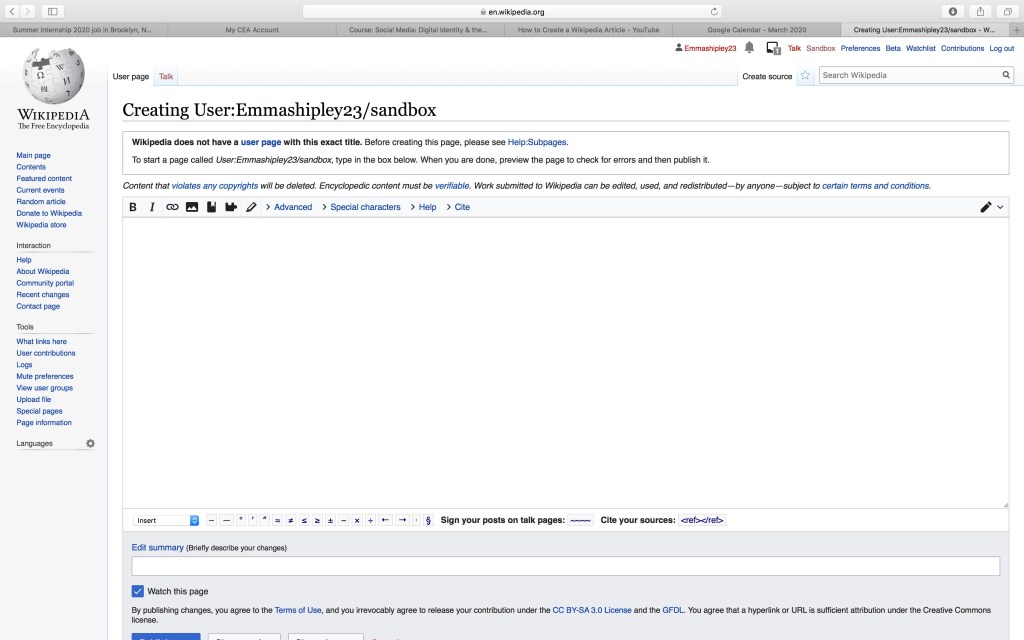
After familiarizing myself with the tools in the Sandbox, I moved onto Article Wizard. The Article Wizard looks like this:

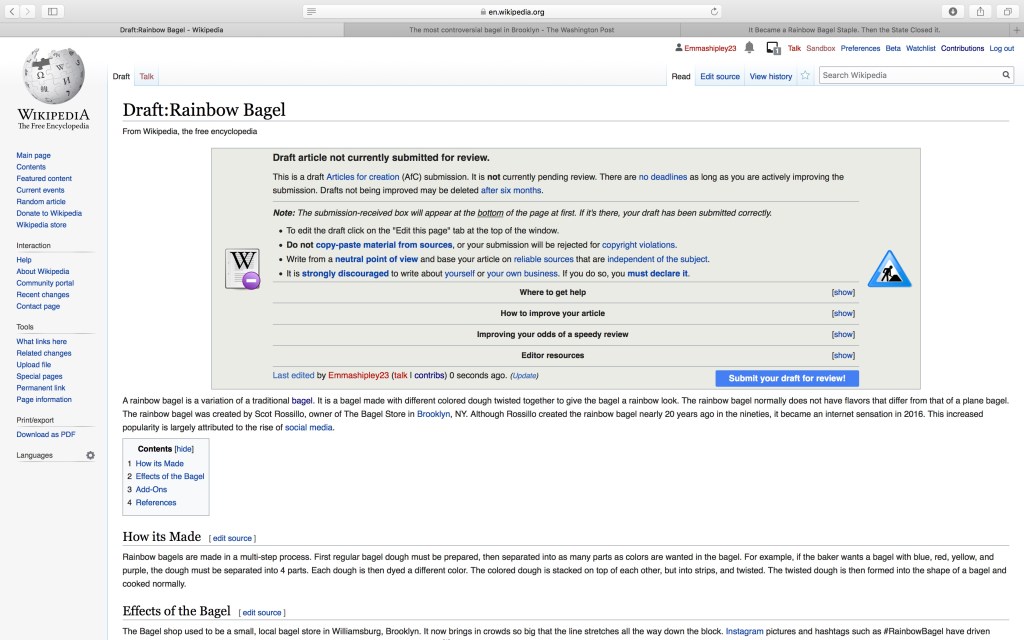
I decided to write my Wikipedia article about rainbow bagels. Rainbow bagels became an internet sensation in 2016 due to social media. They are a delicious treat that popped up all over Instagram and even sparked a movement of other rainbow-colored foods. Rainbow bagels were created not too far from where I am from and they are a treat I still enjoy on weekends.

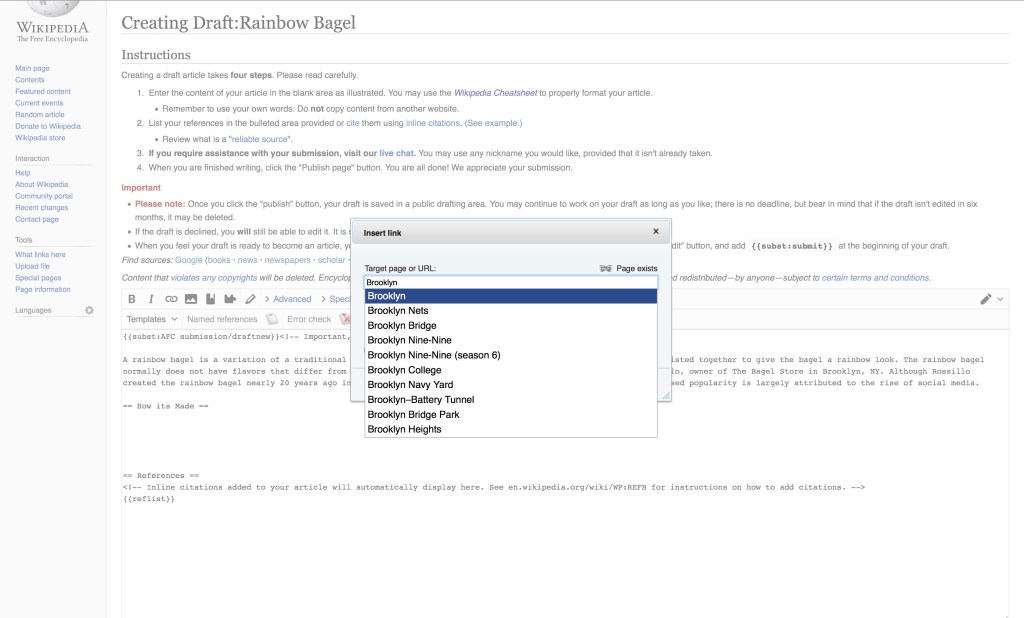
The first thing to do when writing a page is begin with a brief, overall description of the subject, so in my case, rainbow bagels. I included where bagels originated, who created them, and how they grew to fame on social media. During this paragraph I felt that it could be helpful to readers to link a few terms to other Wikipedia articles. To do this, the author should highlight the word or phrase they want to link, then click the link button on the top of the page. Wikipedia will open a pop-up box allowing the writer to fill in the page that they want to page to be linked.

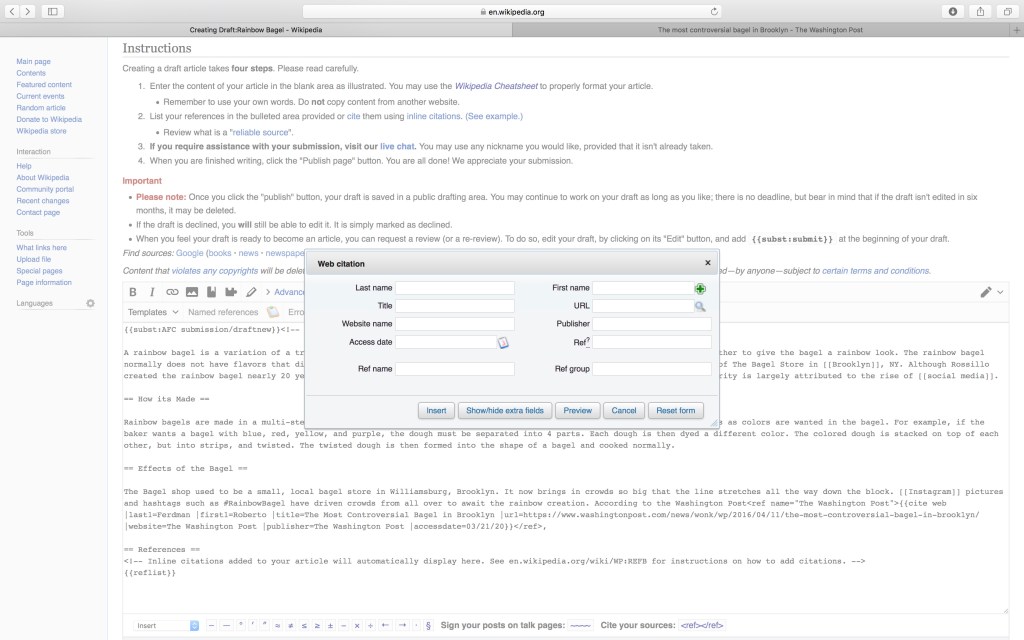
After I finished the first section of my article, I moved on to more descriptive subcategories. To create a new heading for a subcategory, the writer must type: == Heading Name ==.  As I wrote about my more specific topics, I decided I wanted to do deeper research. This required me using outside sources and having to cite them. To site a source, highlight a word or phrase, then click the cite button at the top of the page. Wikipedia will open another pop-up box and request information about the source. Fill out the information and hit insert.

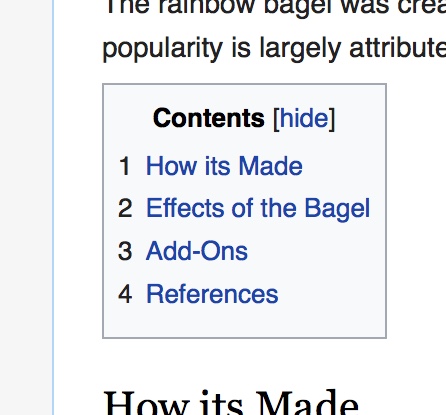
After creating 4 headings, references in included as one heading, Wikipedia automatically creates a table of contents with all the subheadings included in the post.

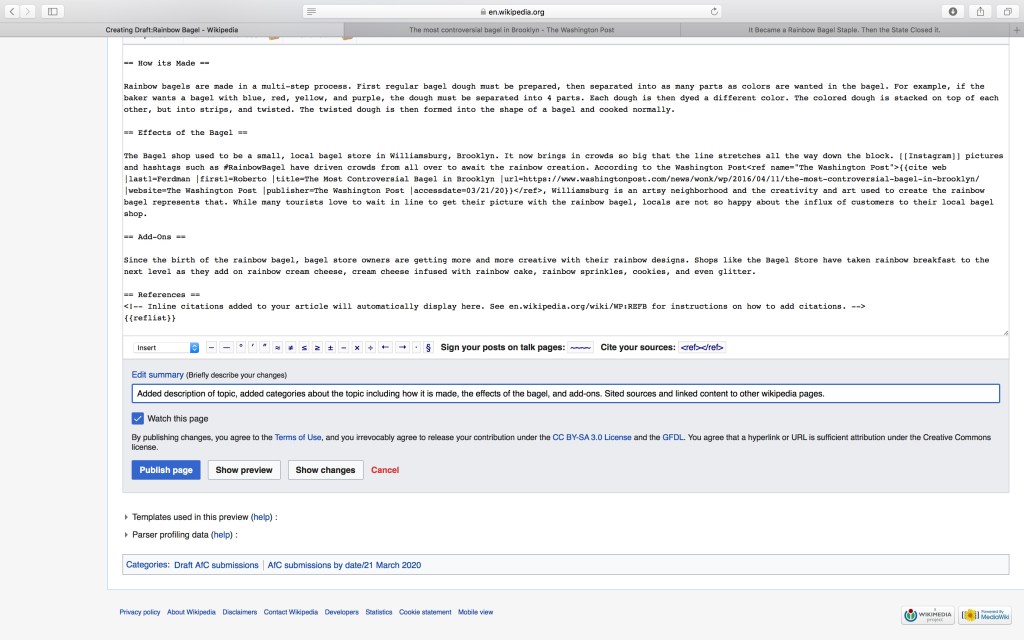
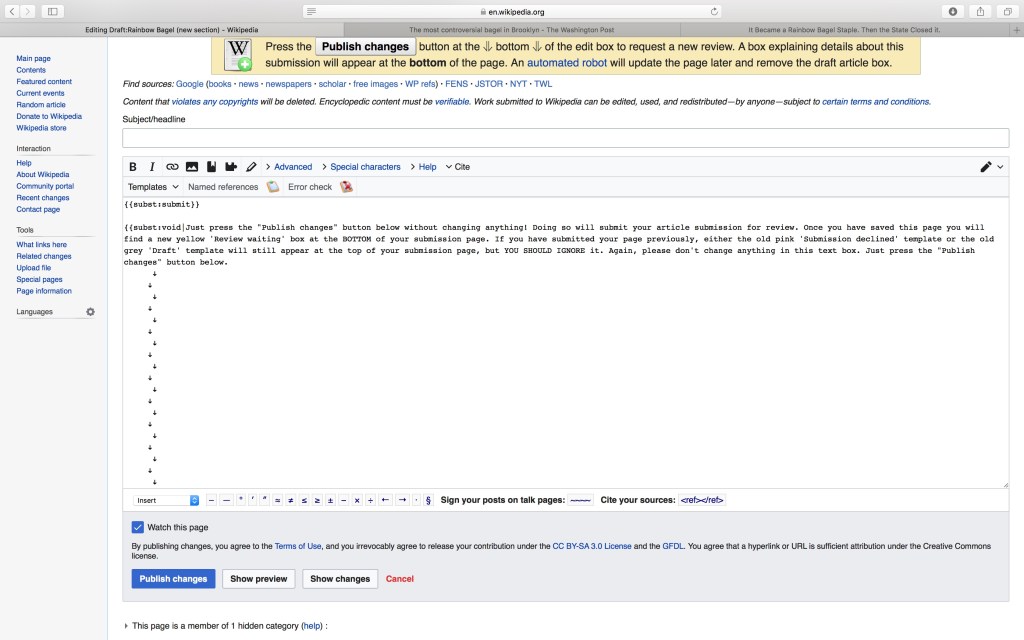
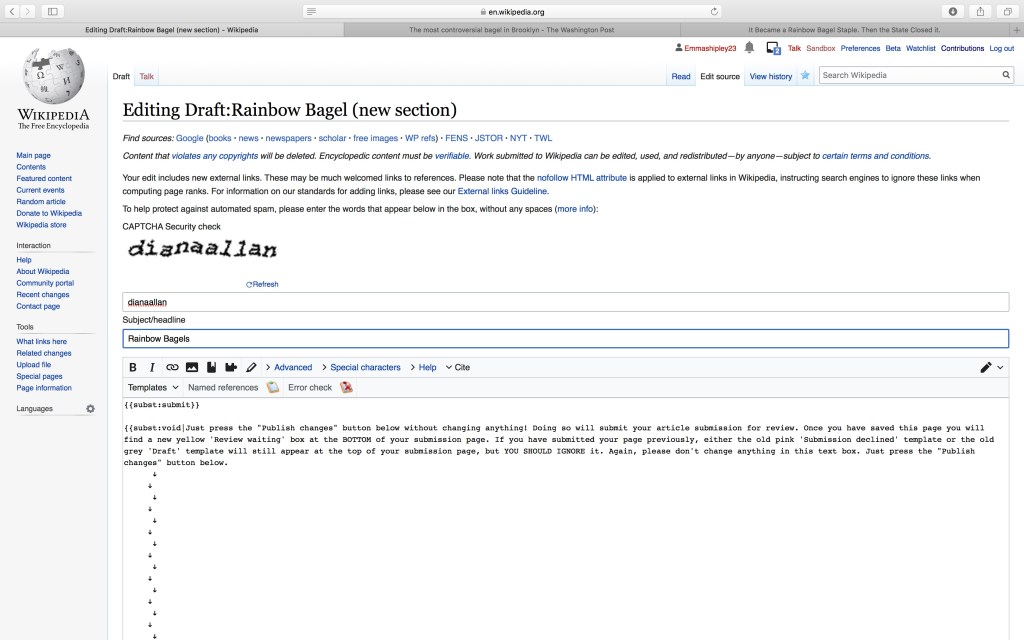
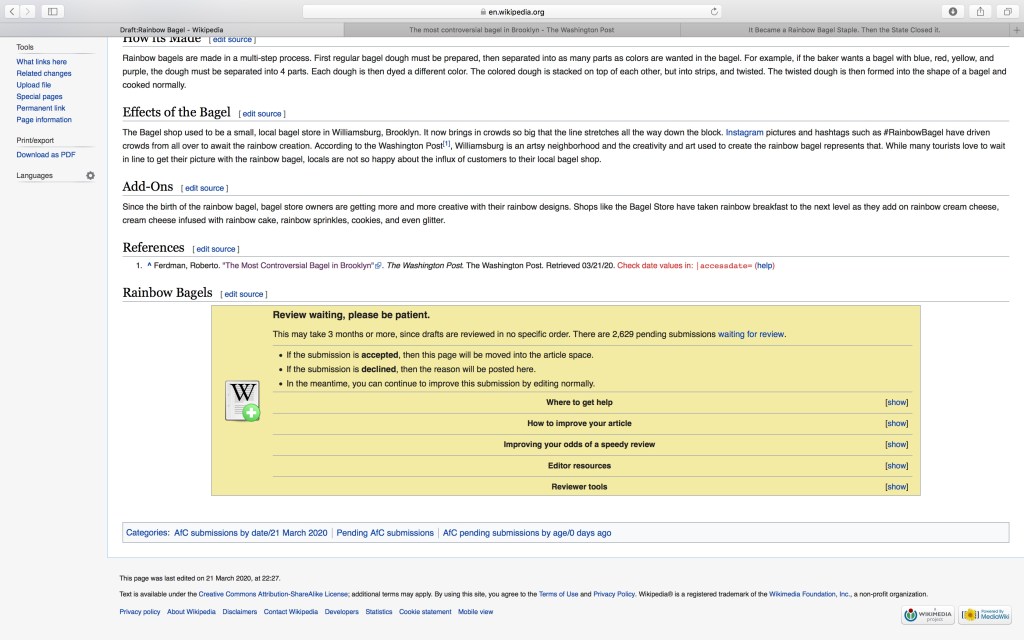
After proofreading the article and checking that all the sources are properly cited, it’s time to publish the page. At the bottom of the page there is a button to publish the article. After clicking submit, Wikipedia brings the writer to a few more pages to review the article format.

After going through the Wikipedia process, I learned about the many steps it takes to create an article. Even after an article is submitted, the page is not published. First, a team of volunteers at Wikipedia must fact check and review the page. Many submissions do not make it past this stage. Although there is a process involved in checking the articles, misinformation can still be submitted. After all, the teach checking the pages are human volunteers, and they make mistakes, too.

For me, it was a bit challenging to learn the software, at first. Wikipedia does not have super clear instructions on their website about how to write and edit an article. I learned the process through watching limited YouTube videos on the topic and a lot of trial and error. Overall, Wikipedia is a very useful tool to find out information, however, I wouldn’t use it as a scholarly source for legitimate research.

Myths and Truths About Gen Z and Millennials

We’ve all heard it before, the whispers from our older relatives or people passing by on the street complaining about generalizations of millennials and gen Z. “They are so lazy, they are glued to their phones, they are so selfish,” they’ll say. I know when I hear statements like that it bothers me. While yes, our generation is different than baby boomers, that doesn’t make all the differences bad. I think a lot of the times people from older generations just don’t always understand all the differences and what they mean for us as a generation.

One of the first “myths” about gen Z I’d like to address is that we are always on our phones. Okay, yes, I will admit I am on my phone a lot, however not always in the way people may think and not in a way that that should invite sneers from baby boomers. Cell phones do a lot. Almost everything, in fact. So, when I am on my phone it is not always to constantly check social media and talk to my friends. I use my phone as a clock, calendar, notepad, search engine, work device, camera, and much more. However, on the topic of social media through phones, yes, I do use it for that, too, but I don’t think its necessarily a generational thing. I fall victim to occasionally scrolling through Instagram and Twitter for hours on end some days, but honestly, the time I spend on all my social media platforms combined does not rival the amount of time my grandma spends on Facebook. Even at family diners I catch her glancing at her phone more than I do. This instance is not unordinary, either. According to Forbes, “in the U.S., there are more Facebook users from the 65 and above age group than those in the 13- to 17-year-old group.”

Another common misconception about millennials and gen Z is that we don’t care about privacy. In an article by Henry Jenkins, “Millennials, New Media, and Social Change,” Jenkins chimes in stating:

It’s a bit of a myth that this current generation doesn’t care about privacy. Most contemporary research in the U.S. indicates quite the opposite – that young people are deeply concerned about privacy and control over information, but they don’t always understand the mechanisms by which their privacy is being violated and they don’t often feel that they have any means of altering trends in the society

– Henry Jenkins

It is terrifying to think about how much companies know about our personal lives. With every box checked that acknowledges that I’ve “read and agreed to terms and conditions” is me signing away my own exclusive access to my data, photos, microphone, name, etc. These are things that I have been made aware of through courses like Journalism, Social Media, and Communication. However, if I wasn’t in an of these classes, and not everyone is, I would have no idea that so much of my private data could be accessed. Additionally, even while I am aware of some of the privacy violations, it doesn’t defer me from using certain apps. I need to allow apps access to my microphone for videos, I need them to have my location for apps, I need to allow them to use my images if I want to continue using social media apps. It is not worth giving up my entire virtual life to worry about the small risk that allowing access to any of my data will actually hurt me somehow in the future. Sure, its creepy, but most millennials would agree, not detrimental.

https://tegnamarketingsolutions.com/5-myths-you-should-stop-believing-about-millennials/

Finally, I would like to look at some of the truths about media use in millennials and gen Z. As much as I hate to admit it, there is some form of truth in almost all of the “myths” about our generation. It is like stereotypes. They usually come about because a few people in a demographic act a certain way, but not everyone. There is truth in saying SOME millennials are on their phones too much, and SOME millennials are completely unconcerned about privacy. While gen Z uses social media and the internet often, we do it in ways that can be beneficial to society and help build communities. Cultural anthropologist Mimi Ito writes, “I am constantly amazed by young people’s unexpected variety of interests, subcultures, and ways of communicating and mobilizing that are supported by today’s digital media.” By offering a world at our fingertips, generation Z is pulling away from the “self-centeredness” of millennials and using the availability of connections to form community and find themselves through others.

2. Henry Jenkins, “Millennials, New Media, and Social Change,” Confessions of an Aca Fan, January 22, 2018.

1. Irfan Jafrey, “Social Media Matters for Baby Boomers,” Forbes, March 6, 2018

3. Mimi Ito, “GENERATION Z ISN’T DEFINED BY TECHNOLOGY,” Pacific Standard, May 6, 2019.


“Woman Yelling at Cat” Meme Analysis

According to Limor Shifman in “Memes in Digital Culture” memes are, “digital content units with common characteristics, created with awareness of each other, and circulated, imitated, and transformed via the Internet by many users. (1)” Memes can be used to criticize society, point out cultural trends, to build an argument, and simply entertain. Memes are iterated and reiterated over time. Shifman writes in a second article, “Memes in a Digital World: Reconciling with a Conceptual Troublemaker,” that “two main repackaging strategies of memes are prevalent on the web: mimicry and remix. (2)” This classifies memes into two types reiteration. Mimicry memes use the same meme template and images but change the words or add other symbols to create new meaning. Meme mixing involves the joining together of two or more memes to create a new meme. While mimicry is used more often, mixing is still common. However, meme mixing is only effective if viewers understand the meaning of both memes involved.

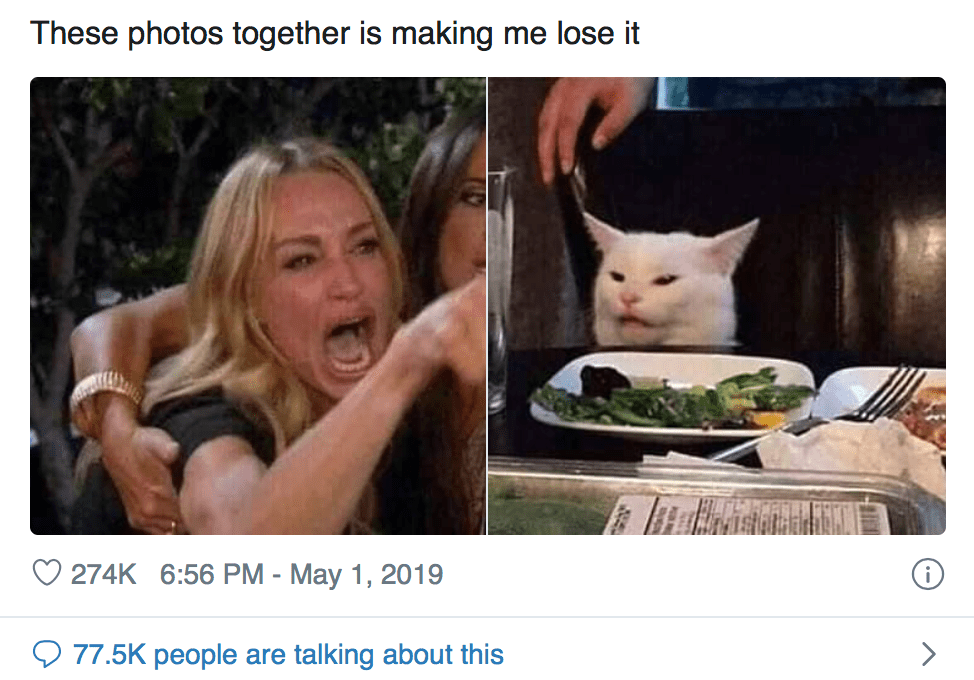
The meme I’ve selected is the “Woman yelling at cat” meme. It is a split screen image where the first half is a woman crying, yelling, and pointing and the other side is a confused looking cat sitting at a dinner table in front of a salad. While the woman isn’t actually yelling at the cat, the spliced images make it appear as though she is. This meme originated when Taylor Armstrong, a reality star on “The Real Housewives of Beverly Hills” aka the “yelling woman” gets into an argument with a fellow cast mate, Camille Grammer, when Armstrong finds out that Grammer was gossiping about her past. The cat, on the other hand, Smudge, is an innocent bystander to the fight and just happens to get caught up in one of the shots. The two images were originally put next to each other in a tweet from @MISSINGEGIRL when she tweeted:

According to Richard Dawkins, the three essential characteristics of memes are fidelity, fecundity, and longevity. Fidelity is a meme’s ability to “hook” its audience. The hundreds of thousands of retweets of the woman yelling at cat meme speak for themselves for the ability of the meme to draw attention to itself. I think that the shock of what appears to be a woman clearly so heated and upset yelling at a cat is what initially grabs the audience’s attention. Fecundity is the ability for a meme to be transmitted and transformed. The woman yelling at cat meme has been both mimicked and mixed. An example of the meme being mixed can be seen below as it crosses over with the Area 51 memes. In order to understand the meme one must have knowledge of the woman yelling at cat meme and the area 51 memes the spurred from the viral Facebook event calling people to storm area 51.

As for longevity, the meme originated in May of 2019 and is still relevant today, in February of 2020. While it has only been around for 9 months, I am confident that it will continue to circulate and evolve in the future. Humor is very important to any meme. If no one thinks it’s funny or relatable, no one will repost it and the meme will die. Personally, I find this meme hilarious. I can’t help but giggle when it pops up as I scroll through social media. Luckily, I am not alone in my enjoyment of it. The meme itself has generated twitter accounts specifically to repost mimics and mixes of the meme and it has even gone as far to inspire some Halloween costumes.

The intertextuality of the meme is its ability to be cross referenced and applied to different events in pop culture. This meme has been modified for the general public and also transformed to relate to specific areas. Many colleges have applied the meme to football programs, especially during playoffs, to fight accusations made by other schools.

View this post on Instagram

🤯

A post shared by Old Row Clemson (@oldrow_clemson) on

In, “What Makes a Video Go Viral? An Analysis of Emotional Contagion and Internet Memes,” Rosanna E. Guadagno, Daniel M. Rempala, Shannon Murphy, and Bradley M. Okdie write that, “Social media commentators have found emotional commonalities between the most popular videos on youtube.com. Specifically, videos that are cute, humorous, or emotionally arousing draw more viewers. (3)” The woman yelling at cat meme appeals to a lot of these emotions. First off, the woman brings the element of emotional arousal with her clear anger. The cat adds the element of “cuteness.” The two images together are humorous and unexpected, which sticks in people’s minds and makes it unique.

1. Guadagno, Rosana E, Daniel M Rempala, Shannon Murphy, and Brad M Okdie. “What Makes a Video Go Viral? An Analysis of Emotional Contagion and Internet Memes.” Science Direct. Accessed February 6, 2020. https://www-sciencedirect-com.libproxy.clemson.edu/science/article/pii/S0747563213001192.

2. Shifman, Limor. 2014. Memes in Digital Culture. MIT Press Essential Knowledge Series. Cambridge, Massachusetts: The MIT Press. http://search.ebscohost.com.libproxy.clemson.edu/login.aspx?direct=true&db=e000xna&AN=649171.

3. Shifman, Limor.  2013. Memes in a Digital World: Reconciling with a Conceptual TroublemakerJournal of Computer-Mediated Communication, Volume 18, Issue 3, Pages 362–377, https://doi-org.libproxy.clemson.edu/10.1111/jcc4.12013

Introduce Yourself (Example Post)

This is an example post, originally published as part of Blogging University. Enroll in one of our ten programs, and start your blog right.

You’re going to publish a post today. Don’t worry about how your blog looks. Don’t worry if you haven’t given it a name yet, or you’re feeling overwhelmed. Just click the “New Post” button, and tell us why you’re here.

Why do this?

  • Because it gives new readers context. What are you about? Why should they read your blog?
  • Because it will help you focus you own ideas about your blog and what you’d like to do with it.

The post can be short or long, a personal intro to your life or a bloggy mission statement, a manifesto for the future or a simple outline of your the types of things you hope to publish.

To help you get started, here are a few questions:

  • Why are you blogging publicly, rather than keeping a personal journal?
  • What topics do you think you’ll write about?
  • Who would you love to connect with via your blog?
  • If you blog successfully throughout the next year, what would you hope to have accomplished?

You’re not locked into any of this; one of the wonderful things about blogs is how they constantly evolve as we learn, grow, and interact with one another — but it’s good to know where and why you started, and articulating your goals may just give you a few other post ideas.

Can’t think how to get started? Just write the first thing that pops into your head. Anne Lamott, author of a book on writing we love, says that you need to give yourself permission to write a “crappy first draft”. Anne makes a great point — just start writing, and worry about editing it later.

When you’re ready to publish, give your post three to five tags that describe your blog’s focus — writing, photography, fiction, parenting, food, cars, movies, sports, whatever. These tags will help others who care about your topics find you in the Reader. Make sure one of the tags is “zerotohero,” so other new bloggers can find you, too.

Design a site like this with WordPress.com
Get started