According to Limor Shifman in “Memes in Digital Culture” memes are, “digital content units with common characteristics, created with awareness of each other, and circulated, imitated, and transformed via the Internet by many users. (1)” Memes can be used to criticize society, point out cultural trends, to build an argument, and simply entertain. Memes are iterated and reiterated over time. Shifman writes in a second article, “Memes in a Digital World: Reconciling with a Conceptual Troublemaker,” that “two main repackaging strategies of memes are prevalent on the web: mimicry and remix. (2)” This classifies memes into two types reiteration. Mimicry memes use the same meme template and images but change the words or add other symbols to create new meaning. Meme mixing involves the joining together of two or more memes to create a new meme. While mimicry is used more often, mixing is still common. However, meme mixing is only effective if viewers understand the meaning of both memes involved.
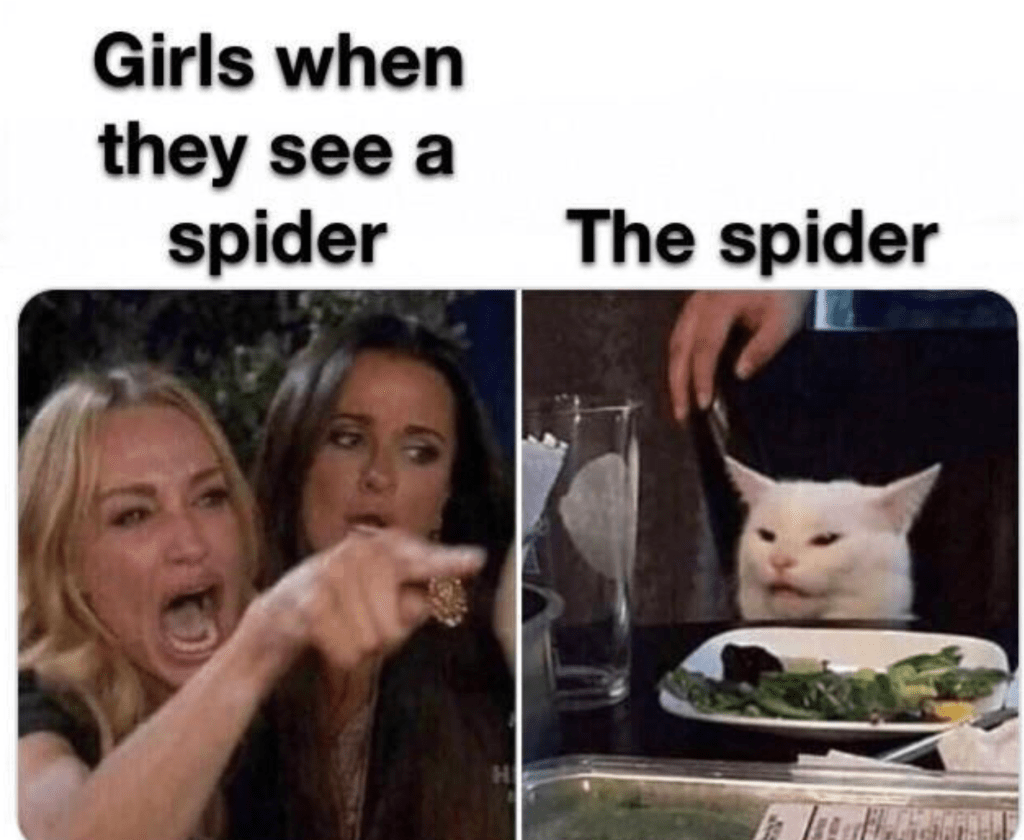
The meme I’ve selected is the “Woman yelling at cat” meme. It is a split screen image where the first half is a woman crying, yelling, and pointing and the other side is a confused looking cat sitting at a dinner table in front of a salad. While the woman isn’t actually yelling at the cat, the spliced images make it appear as though she is. This meme originated when Taylor Armstrong, a reality star on “The Real Housewives of Beverly Hills” aka the “yelling woman” gets into an argument with a fellow cast mate, Camille Grammer, when Armstrong finds out that Grammer was gossiping about her past. The cat, on the other hand, Smudge, is an innocent bystander to the fight and just happens to get caught up in one of the shots. The two images were originally put next to each other in a tweet from @MISSINGEGIRL when she tweeted:
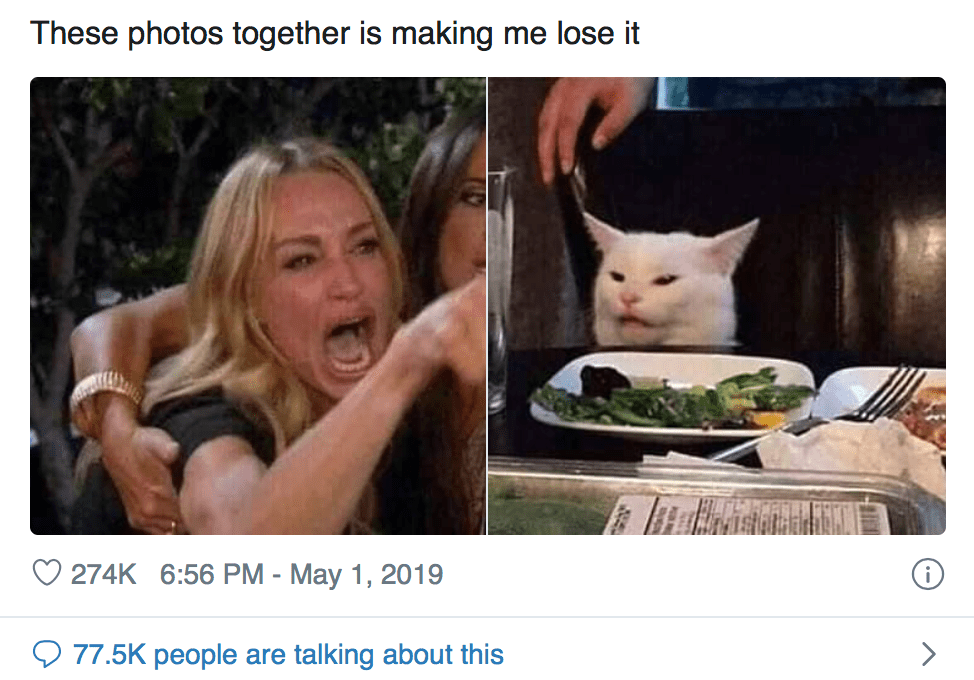
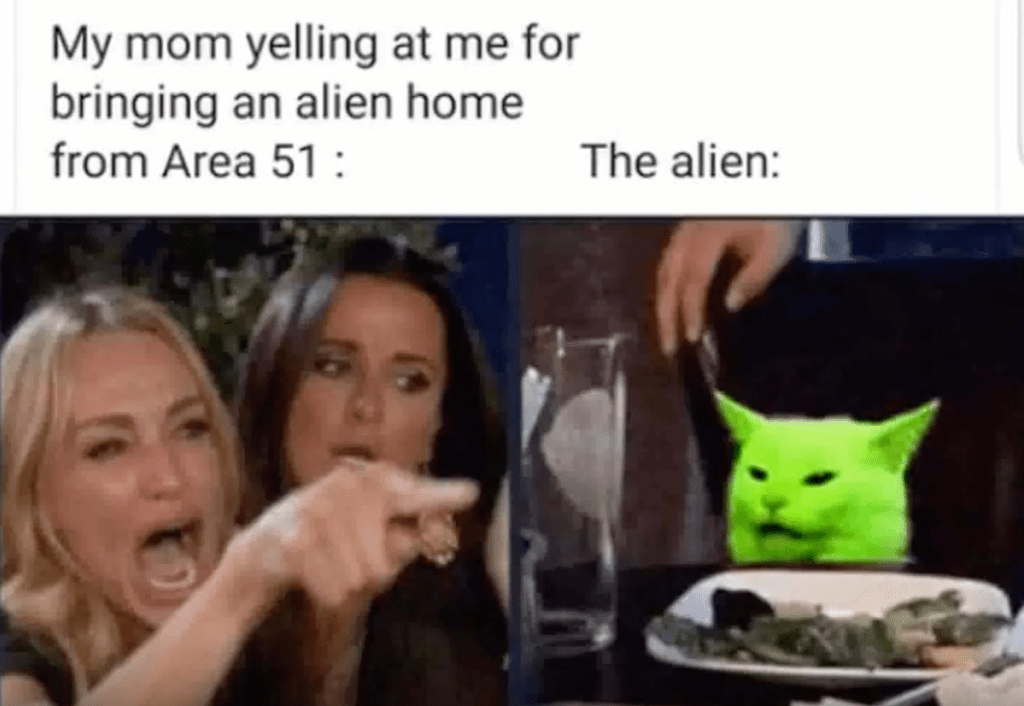
According to Richard Dawkins, the three essential characteristics of memes are fidelity, fecundity, and longevity. Fidelity is a meme’s ability to “hook” its audience. The hundreds of thousands of retweets of the woman yelling at cat meme speak for themselves for the ability of the meme to draw attention to itself. I think that the shock of what appears to be a woman clearly so heated and upset yelling at a cat is what initially grabs the audience’s attention. Fecundity is the ability for a meme to be transmitted and transformed. The woman yelling at cat meme has been both mimicked and mixed. An example of the meme being mixed can be seen below as it crosses over with the Area 51 memes. In order to understand the meme one must have knowledge of the woman yelling at cat meme and the area 51 memes the spurred from the viral Facebook event calling people to storm area 51.
As for longevity, the meme originated in May of 2019 and is still relevant today, in February of 2020. While it has only been around for 9 months, I am confident that it will continue to circulate and evolve in the future. Humor is very important to any meme. If no one thinks it’s funny or relatable, no one will repost it and the meme will die. Personally, I find this meme hilarious. I can’t help but giggle when it pops up as I scroll through social media. Luckily, I am not alone in my enjoyment of it. The meme itself has generated twitter accounts specifically to repost mimics and mixes of the meme and it has even gone as far to inspire some Halloween costumes.
The intertextuality of the meme is its ability to be cross referenced and applied to different events in pop culture. This meme has been modified for the general public and also transformed to relate to specific areas. Many colleges have applied the meme to football programs, especially during playoffs, to fight accusations made by other schools.
In, “What Makes a Video Go Viral? An Analysis of Emotional Contagion and Internet Memes,” Rosanna E. Guadagno, Daniel M. Rempala, Shannon Murphy, and Bradley M. Okdie write that, “Social media commentators have found emotional commonalities between the most popular videos on youtube.com. Specifically, videos that are cute, humorous, or emotionally arousing draw more viewers. (3)” The woman yelling at cat meme appeals to a lot of these emotions. First off, the woman brings the element of emotional arousal with her clear anger. The cat adds the element of “cuteness.” The two images together are humorous and unexpected, which sticks in people’s minds and makes it unique.
1. Guadagno, Rosana E, Daniel M Rempala, Shannon Murphy, and Brad M Okdie. “What Makes a Video Go Viral? An Analysis of Emotional Contagion and Internet Memes.” Science Direct. Accessed February 6, 2020. https://www-sciencedirect-com.libproxy.clemson.edu/science/article/pii/S0747563213001192.
2. Shifman, Limor. 2014. Memes in Digital Culture. MIT Press Essential Knowledge Series. Cambridge, Massachusetts: The MIT Press. http://search.ebscohost.com.libproxy.clemson.edu/login.aspx?direct=true&db=e000xna&AN=649171.
3. Shifman, Limor. 2013. Memes in a Digital World: Reconciling with a Conceptual Troublemaker, Journal of Computer-Mediated Communication, Volume 18, Issue 3, Pages 362–377, https://doi-org.libproxy.clemson.edu/10.1111/jcc4.12013
 Everything Emma